
The value of high frequency testing
By Guido Farji
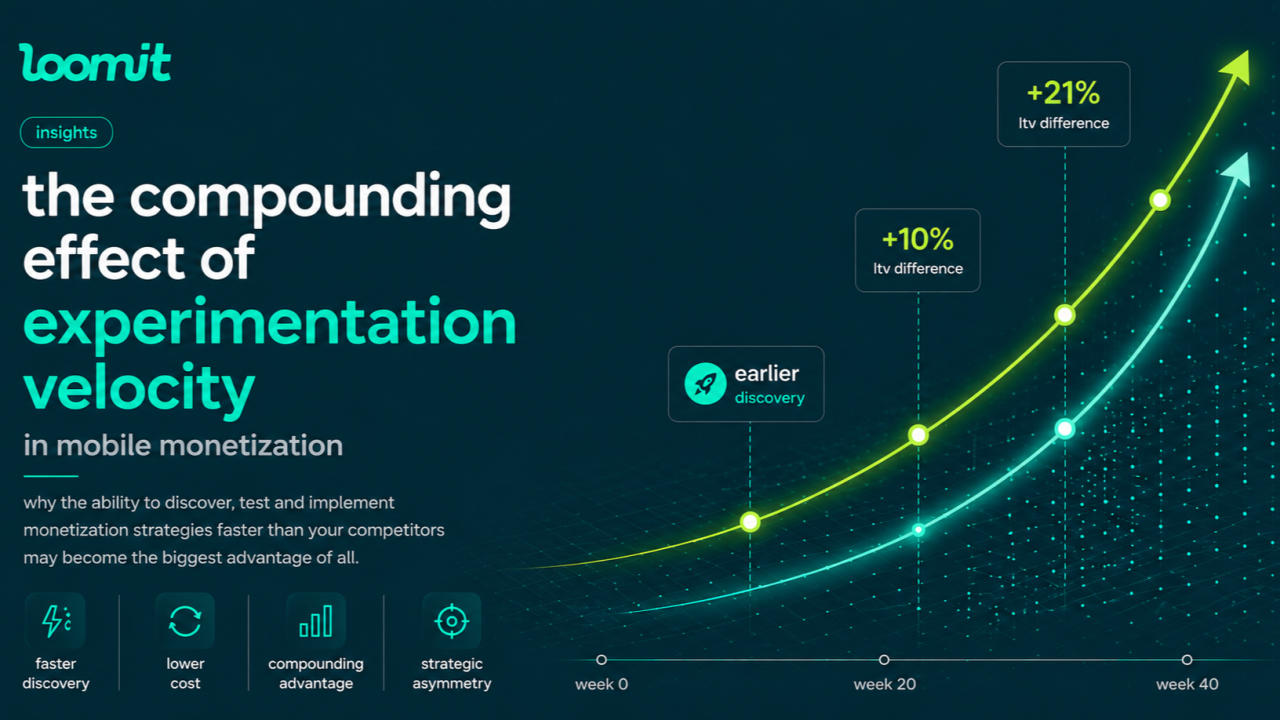
Since we launched Loomit.ai and started working with sophisticated publishers around the world, we talked a lot about functionalities, optimization systems, segmentation models, Dynamic Price Floors, AI, MetaMediation and many other concepts associated with modern AdMon.
And honestly, that makes sense.
At the end of the day, this is still a business about improving monetization performance and maximizing LTV.
However, I think there is a much deeper effect happening underneath all those improvements, and strangely enough, I believe the industry is still massively underestimating it.
The real revolution is not the uplift itself.
The real revolution is the acceleration of discovery.
And in mobile gaming, that changes everything.
Compound Interest Is the King
In the financial world, compound interest is usually called the most powerful force in investing.
Mobile gaming works in a surprisingly similar way.
If two publishers eventually discover two monetization strategies that improve LTV by 10%, but one of them discovers it 30 weeks earlier, the impact is not linear.
That publisher starts capitalizing the result earlier.
Earlier capital means:
more cash flow,
more UA competitiveness,
more scale,
more learning,
more reinvestment capacity,
and faster progression into the next optimization cycle.
This is what many people call the Golden Circle.
The faster you improve your monetization economics, the more aggressive you can become acquiring users. The more users you acquire, the more data and monetization opportunities you generate. The more opportunities you generate, the more experiments you can run. And the cycle accelerates itself.
Obviously no model is perfect. Mobile gaming is chaotic by nature.
But the magnitude of the advantage can become radical over time.
And this is exactly where I believe most publishers are still massively underestimating the strategic impact of operational velocity in AdMon.
The Hidden Cost Nobody Measures Correctly
When publishers think about monetization experimentation, most of them think about the potential uplift.
Very few think seriously about the operational economics of experimentation itself.
Because experimentation is not free.
Even sophisticated publishers with internal tooling still depend heavily on engineering resources for most meaningful monetization experiments.
And this creates a hidden tax on iteration.
Let’s take a fairly typical scenario.
A publisher wants to test:
a new segmentation logic,
different price floor behavior,
a new pacing strategy,
format orchestration,
dynamic cooldowns,
reward variations,
or some kind of hybrid mediation setup.
In a traditional setup, this usually means:
technical planning,
engineering implementation,
QA,
release cycles,
rollout,
adoption periods,
monitoring,
and eventually rework.
If we are honest about the real TCO of this process, including management overhead and opportunity cost, a sophisticated experiment can easily represent around 6000 USD in hidden operational costs.
And even worse than the money is the time.
In practice, publishers often spend around:
2 weeks in development,
1 week in rollout/adoption,
and only then start the actual experiment.
Meaning that a single iteration can easily consume 4 weeks.
Now extrapolate this over time.
If the meaningful discovery happens around experiment number 10, one publisher reaches that point in 40 weeks.
Another reaches it in 10.
That difference is enormous.
Not only because of the direct monetization gain, but because one publisher spent almost an entire year compounding advantages while the other was still trying to operationalize experimentation.
The Psychological Cost of Failure
There is another part of this conversation that almost nobody talks about.
Experimentation becomes psychologically exhausting when every iteration is expensive.
After a few failed tests, teams start hearing things like:
“Again we are going to spend engineering resources on this?”
“We already spent 4 months testing things.”
“Nothing meaningful happened.”
“Maybe we should prioritize something else.”
And honestly, they are not wrong.
Because the process itself is operationally painful.
So what happens?
Most publishers abandon experimentation long before reaching enough iterations to discover something truly transformative.
Not because they lack intelligence.
Not because they lack ideas.
But because operational friction kills exploration.
This is probably one of the most underestimated problems in the entire AdMon ecosystem.
Why Loomit Changes the Equation
At its core, Loomit is not only a monetization platform.
It is an experimentation operating system.
What Loomit changes is not simply the monetization result.
It changes the economics of exploration itself.
Most sophisticated experiments that traditionally require engineering, QA and deployment cycles can be configured in Loomit in minutes, without consuming engineering resources.
This radically changes the cost structure of experimentation.
If the experiment itself still requires 7 days to collect statistically meaningful data, but the operational setup disappears, then what previously took 4 weeks now takes 1.
That means:
10 experiments in 10 weeks instead of 40,
dramatically lower operational costs,
almost no engineering friction,
and experimentation becoming economically viable at scale.
And this is where the compounding effect starts becoming extremely powerful.
Because the publisher is no longer optimizing only monetization.
The publisher is optimizing discovery velocity.
The Strategic Consequence
This is why I believe the industry still underestimates what operating systems like Loomit are actually doing.
The real value is not simply:
“this feature improved ARPDAU by X%”.
The real value is:
discovering opportunities earlier,
iterating faster,
compounding results sooner,
and creating strategic asymmetry through operational speed.
Over time, this changes:
UA competitiveness,
scale efficiency,
profitability,
retention optimization,
and ultimately market positioning itself.
So no, I honestly don’t believe the real value of Loomit is only the extra 10% or 20% of LTV a publisher eventually discovers.
The real value is discovering what nobody else discovered:
earlier,
faster,
cheaper,
and before competitors even get close.