
Moving Beyond Features: How to Build a Durable Monetization Strategy
By Loomit Team
We Talk Too Much About Features
Most content published about ad monetization — including ours — gravitates toward the specific. A new format toggle. A case study on reducing interstitials. A strategy for improving store ratings. These are useful things to discuss, and they reflect real problems that real studios are trying to solve.
But there is a risk in that framing. It implies that monetization improvement is a series of discrete interventions: add this feature, run this test, apply this tactic. Fix one thing, move to the next. The assumption is that somewhere at the end of the road there is a configuration that is optimized, and the goal is to reach it.
That is not how it works. And this post is about the process itself — what a coherent, durable monetization strategy actually looks like when you step far enough back to see the whole thing.
The Hierarchy: Tools, Solutions, Playbooks, Strategy
There is a useful way to think about how the components of an ad monetization platform relate to one another. At the base level, you have tools — individual capabilities that do a specific thing. Smart Buffering preloads ads ahead of an impression. Capping rules limit the number of times a user sees a format within a session. Segments group users by behavioral or predictive properties. Each of these is well defined and does exactly what it says.
One level up, tools combine into solutions — approaches that address a specific problem or objective. Smart Buffering is a prerequisite for Interchangeable Ad Formats, which dynamically swaps between interstitial and rewarded video at impression time to serve whichever earns the higher CPM. It is also the foundation for Multiple Calls, which runs parallel ad unit requests to maximize both fill rate and CPM simultaneously. Neither solution exists without the underlying tool. But the tool alone would not have told you what to do with it.
Above solutions sit playbooks — a series of solutions combined to target a specific KPI or user situation. How should ads be managed during onboarding if the goal is to improve store ratings? How does that change if the objective shifts to conversion to payer? Should all networks run, or should some be excluded? What does the cooldown logic look like for each case? A playbook answers these questions for a defined scenario, packaging the relevant solutions into a repeatable approach that can be tested, refined, and applied across segments.
Above playbooks sits strategy — the deliberate, coherent plan that determines which playbooks to test on which user segments, measured against which outcomes. Strategy is where the individual pieces stop being a list of features and start being a system. This is also the level where most publishers spend the least time.
A buffer is nothing but a buffer. Combined with segmentation and the right architecture, it becomes the foundation for format comparison, latency management across multiple ad units, and CPM maximization at impression time. The tool is the same. What changes is the strategy around it.
The Five Steps of a Monetization Strategy
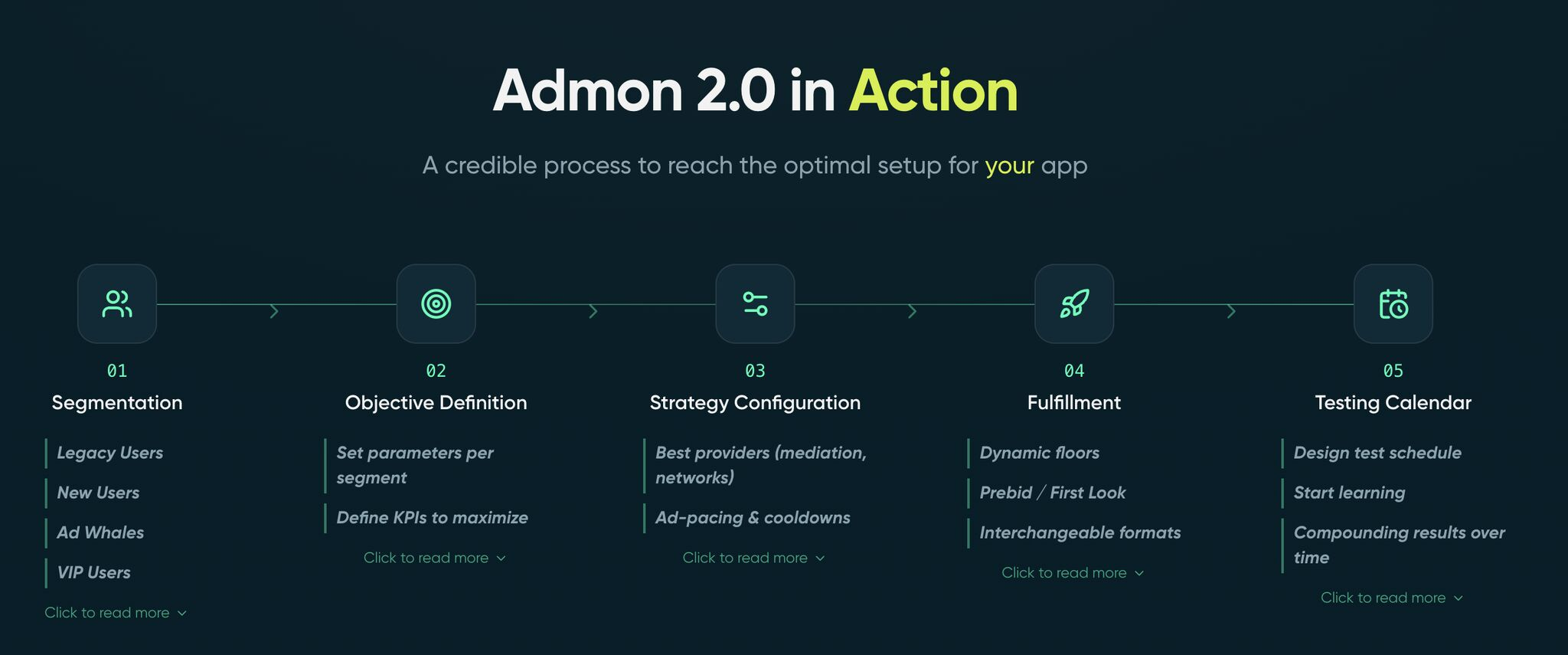
When we look at how the studios producing consistently strong monetization results actually operate, a clear pattern emerges. They apply tools within a structured process that keeps the full picture in view. That process has five stages.
Step One: Segmentation
Every strategy starts by asking who is in the user base and what meaningful distinctions exist between them. Not all users should be monetized the same way — their behavioral profiles differ, their monetization potential differs, and the experience that serves them well differs accordingly.
The most useful segments at this stage are typically defined by a combination of source (where the user came from), engagement depth (how much they use the app), monetization potential (what their CPM history or purchase likelihood looks like), and tenure (how long they have been active). Common segment archetypes that emerge from this exercise include new users in their first sessions, legacy users with established patterns, high CPM users who generate disproportionate ad revenue, and potential buyers whose behavioral signals indicate purchase intent.
The segmentation step is foundational because everything that follows is defined at the segment level. A strategy that does not start here is not a strategy — it is a global configuration applied uniformly to a population that is not uniform.
Step Two: Objective Definition
Once segments are defined, the next question is what each one is supposed to do. This sounds obvious but it is consistently skipped. Publishers often treat revenue maximization as a universal objective, applied to every user at all times. The problem is that for many segments, short term revenue maximization directly undermines the more valuable long term outcome.
A segment of users identified as likely IAP converters should have an objective centered on conversion, not ad impressions. Showing that segment aggressive interstitial frequency may generate ad revenue in the short term while destroying the purchase conversion that makes those users genuinely valuable. Incentivized users tend to have high demand for rewarded ads as they help them get to their target sooner; maybe we should increase those ad opportunities. A legacy high engagement segment may warrant an objective of sustained retention alongside revenue.
Defining the objective per segment is the step that makes subsequent configuration decisions coherent. Without it, every configuration choice is arbitrary.
Step Three: Strategy Configuration
With segments defined and objectives set, the strategy configuration step is where you select the playbook and design the delivery mechanics that will pursue each objective. The questions at this stage are practical and specific:
- Which mediation platform and ad network waterfall is best suited for this segment's profile — not all mediators perform equally across all user types
- What capping and pacing rules govern impression frequency, to balance revenue delivery against experience quality for the specific objective in play
- What cooldown logic applies between ad exposures, and whether that logic varies by format within the segment
- What format mix is appropriate — whether this segment should see interstitials, rewarded video, a dynamic combination of both, or nothing at all for a defined period
- What routing rules apply if the segment has geographic, device, or behavioral sub-dimensions that warrant further differentiation
A useful way to frame this step is to ask: what playbook are we running for this segment, and what constraints or limitations do we need to work within? The answers shape the configuration. Loomit allows all of these decisions to be set, adjusted, and tested from a single interface without code changes — meaning the playbook can evolve as evidence accumulates.
Step Four: Auction Tuning
Only at this point does CPM optimization become the primary focus. With the right users in the right segments, with objectives defined and delivery mechanics configured, the auction tuning step concentrates on extracting the maximum value from each impression that is already being served to the right person in the right context.
This includes setting and refining dynamic price floors to push bids higher without sacrificing fill rate. It includes evaluating Prebid and First Look configurations to ensure the most competitive demand is given priority access. It includes activating Interchangeable Ad Formats where Smart Buffering is in place, so that at every impression moment the highest earning format wins. And it includes using the Multiple Calls architecture to maximize the probability that a high value ad is available when the moment arrives.
These are powerful levers. They are most powerful when applied within a well defined segment operating toward a clear objective. Applied globally across a blended user base with no upstream segmentation, the signal they produce is diluted and the gains are partial.
Step Five: The Testing Calendar
The final element of the process is not a configuration step — it is an ongoing discipline. A testing calendar means that at any given time there is a structured program of experiments running across segments, each designed to test a specific hypothesis about whether a change in configuration improves the outcome the segment is being measured against.
The testing calendar is what prevents the strategy from calcifying. Markets shift. User behavior changes. Network performance evolves. What worked six months ago may be suboptimal today, not because it was wrong then, but because the context has changed. The only way to know is to keep testing.
Running effective tests requires enough volume in each segment to achieve statistical significance within a reasonable timeframe. It requires clear primary metrics aligned to the segment objective — ARPAU for revenue cohorts, conversion rate for buyer cohorts, retention for new user segments. And it requires a discipline of reading results and acting on them, then designing the next test based on what was learned.
There is no arrival date. A monetization strategy is not something you build and finish. It is something you run — continuously, iteratively, with the understanding that the best configuration for your app today will not be the best configuration for your app next quarter.
Why This Matters Now
The gap between studios that manage monetization this way and those that do not is growing. As the mobile advertising market matures and marginal CPM gains from auction optimization become harder to find, the advantage shifts toward publishers who have built the structural foundations — segmentation, objective clarity, deliberate delivery configuration — that make every optimization layer more effective.
Short term CPM chasing is not going away, and it is not without value. But it is increasingly a commodity. The publishers generating outsized monetization results are doing so because they have thought carefully about who their users are, what they want from each of them, and how to build an ad experience that serves that objective over time. That thinking is not a feature. It is a discipline.
Running this process well also means staying alert to the factors that shift the baseline. Seasonality changes CPM dynamics in ways that can make last quarter's optimal configuration suboptimal today. Shifts in UA strategy change the composition of incoming segments and can invalidate the assumptions that playbooks were built on. And the only reliable way to know whether what you are doing still works is to audit regularly — not sporadically, but as a standing habit built into the process.
What Loomit provides is the infrastructure to run this cycle, the models needed to inform decisions where data science is required, and the insights to help publishers navigate each stage efficiently. The goal is not endless testing — it is smart testing at scale, conducted with enough rigor to move the needle and enough structure to know why it moved.