
Managing Rewarded Video Templates
By Loomit Team
The Problem Nobody Talks About
If you've ever tried to standardize ad templates across multiple ad networks, you know the drill. You email your account manager. They forward the request to their network's ad ops team. A week later, you follow up. They say it's done. Two weeks after that, you run an audit and realize half the changes were never actually implemented — or were quietly reverted during a platform update.
This isn't a hypothetical. It's the reality for most mobile publishers running Rewarded Video (RV) across a multi-network stack. Managing ad templates — particularly ensuring shorter, less intrusive ad experiences for your most valuable users — has historically required a painful mix of manual coordination, endless follow-up emails, and near-zero visibility into whether your requests were honored.
The Conversation That Started It All
The idea for this feature actually emerged from a conversation between Loomit co-founder Ignacio Ortiz Freuler and two industry veterans: Felix Braberg and Éric Tournié. They were discussing the ongoing challenge of managing ad templates across networks — and the lack of publisher-side control over how ads are actually presented to users.
That conversation sparked a question that Loomit's team couldn't let go: what if publishers didn't need to rely on network-side implementation at all? What if a single, platform-level toggle could give publishers direct control over the ad experience — instantly, reversibly, and measurably?
"When we hear about client-side pain points, we start thinking fast." — Ignacio Ortiz Freuler, Co-founder, Loomit
What Loomit Built: The Conservative Format Toggle
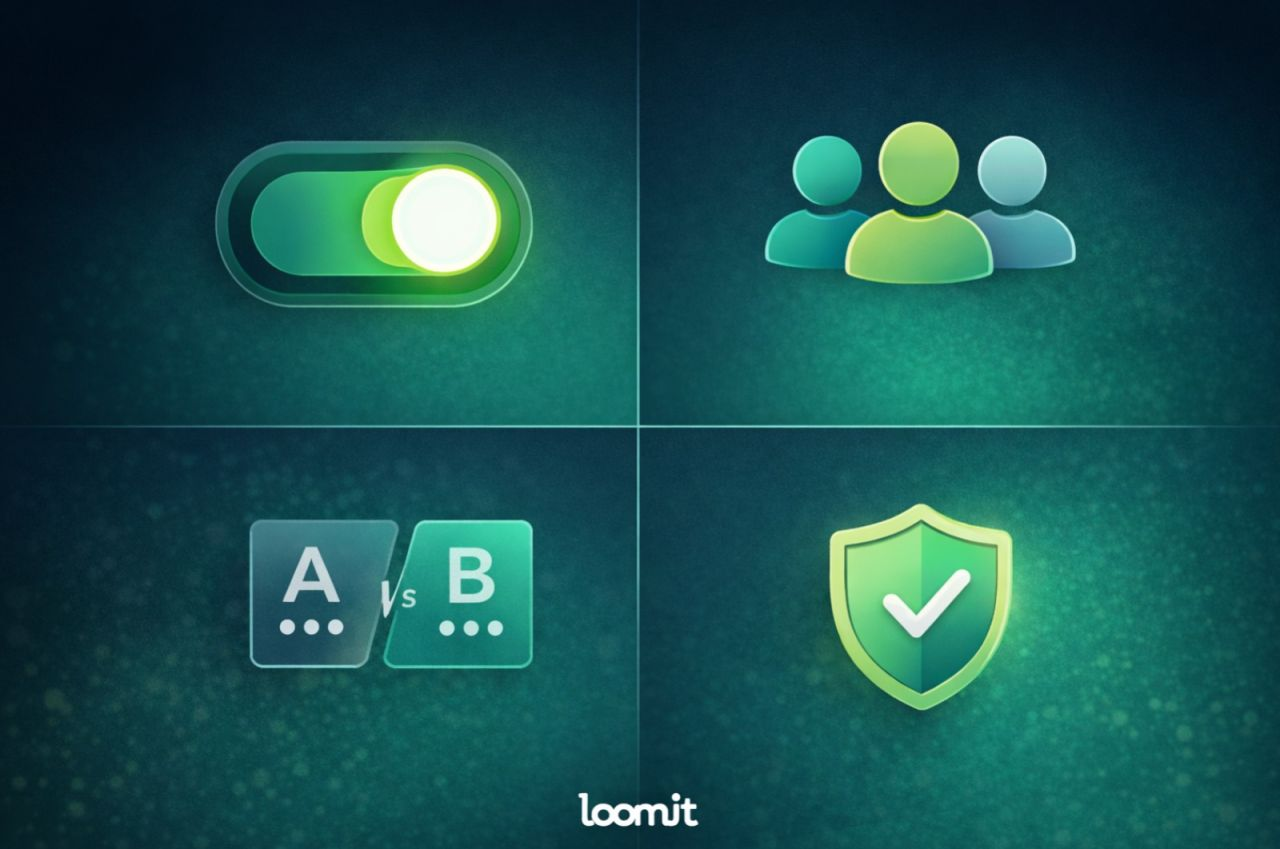
One week after that conversation, Loomit shipped a new feature: the Conservative Format toggle. Available directly inside the Loomit platform, this single toggle allows publishers to prioritize shorter ads across all Rewarded Video placements — without needing to contact a single ad network.
Here's what makes it genuinely different:
Works across all networks simultaneously — not just one at a time
Operates at the segment level — you can enable it for VIP users, new users, or any custom cohort
Takes effect instantly, with no app release or developer involvement required
Is fully reversible — flip it off and things return to normal in seconds
Is A/B testable — run a controlled experiment comparing Conservative vs. Standard format behavior directly from the Loomit dashboard
What It Means for Your Monetization Strategy
The Conservative Format toggle is more than a convenience feature — it's an unlock for a class of experiments that most publishers couldn't run before.
Consider a common scenario: your highest-value user cohort (say, VIP users who have made in-app purchases) is showing early signs of churn. You have a hypothesis that intrusive ads are contributing to the drop-off. In the past, testing this hypothesis would have required coordinating across multiple ad ops teams, risking inconsistent implementation, and waiting days or weeks for changes to take effect.
Now, you can isolate that cohort, flip the toggle, and start measuring the impact on ad duration, eCPM, and retention — all from a single platform. Key capabilities include:
Easy: One toggle, instant effect, reversible at any time
Measurable: Track ad duration, eCPM, and retention shifts directly in the dashboard
Granular: Set per segment for tailored user experiences
Testable: A/B test Conservative vs. Standard configurations to understand the true trade-off
Version 1.0: A First Step, Not the Last
This is version 1.0 — and we’re honest about what that means. The current toggle can’t control precisely when or where a skip button appears within an ad, and it doesn’t yet offer precise ad length management down to the second. Some of these constraints are inherent to the ad itself; others are problems we are actively working to solve. We shipped what works today because we believe publishers have been waiting long enough for even an imperfect version of this capability — and because getting something real into clients’ hands is how we learn what to build next.
The goal isn’t perfection on day one. It’s meaningful progress on a pain point that has gone unaddressed for too long. For publishers who have been stuck choosing between ‘do nothing’ and ‘spend weeks coordinating with networks,’ a single cross-network toggle that works, can be tested, and is reversible anytime represents a real shift — even if it’s only the first version of what this feature will eventually become.
What's Next
This feature was built in one week as a direct response to a real client pain point. It’s a deliberate first step. We shipped it fast to establish a working foundation, get it into clients’ hands, and start collecting the feedback that shapes what comes next. The roadmap from here is strong.
There is a lot we want to build next. On the format side, we are working to bring the same publisher-side controls to other ad formats — interstitials and beyond — so that the Conservative Format concept stops being a Rewarded Video feature and becomes a platform-wide approach to ad experience management. On the precision side, we are developing more granular controls: better ad length visibility, deeper quality metrics at the network level, and tighter feedback loops between what you configure and what you actually measure in your dashboard. On the automation side, the long-term vision is to remove the manual step entirely — letting our models learn which format configurations work best for which user segments, and apply them in real time without publisher intervention. The broader vision is clear: ad experience management should be a first-class capability for every publisher, not an afterthought left to network-side coordination. We’re building toward that — one iteration at a time.
Loomit is building the strategy layer that publishers have always needed but never had. This is credible, supply-side focused adtech — available for all.
Related reading: Improve ad quality and user experience