
Monetization Is No Longer a Setup. It Is a Real-Time Decision System.
By Guido Farji
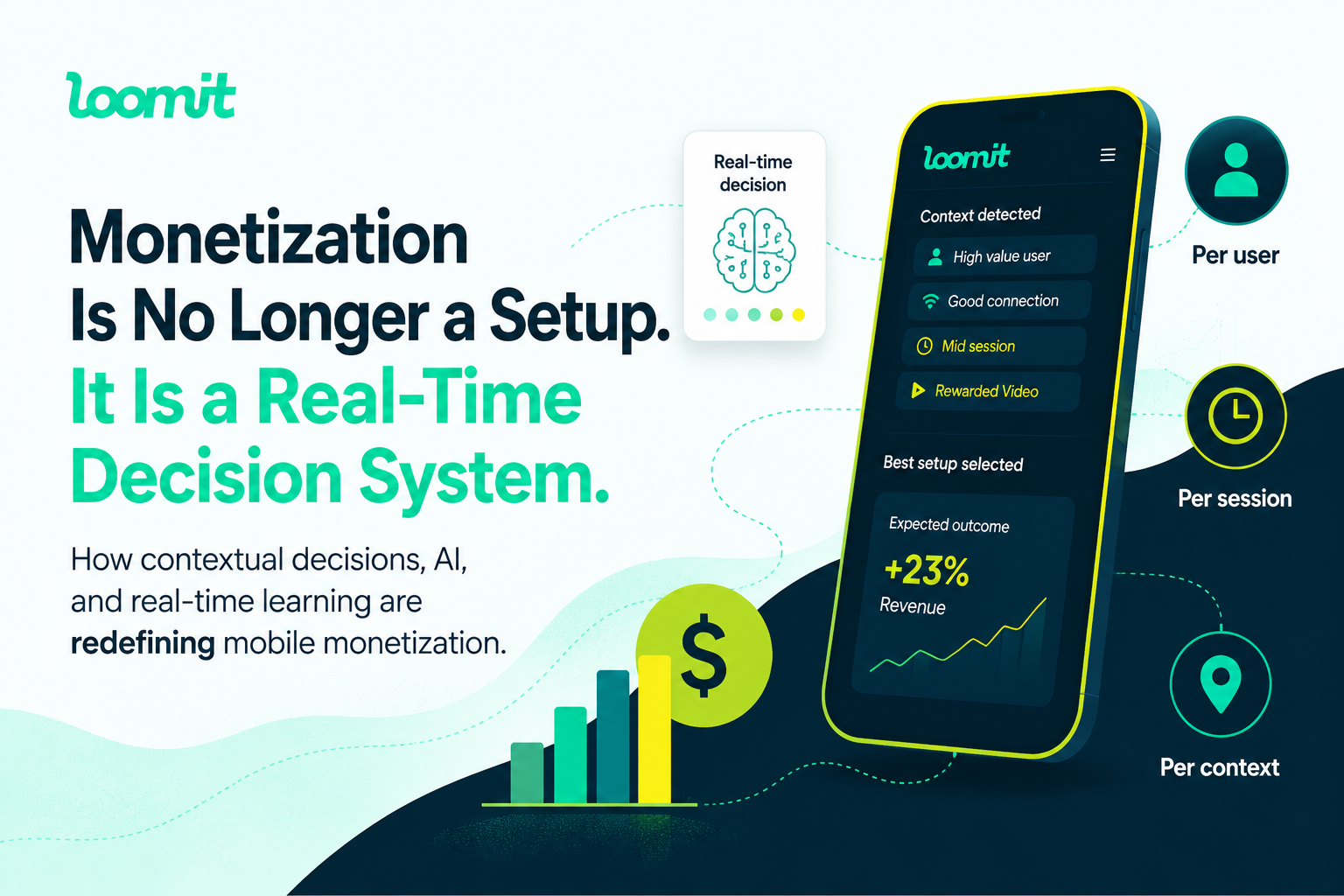
For many years, mobile monetization was treated like a setup.
You choose the mediation.
You connect the networks.
You define the ad units.
You set the floors.
You run some A/B tests.
You look at the results.
You adjust.
And that was it.
That worked when the system was simpler.
Today, not anymore.
Every impression now depends on dozens of signals changing in real time:
- the user
- the session
- the device
- the connection
- the country
- the ad format
- the placement
- network performance
- user value
- buffered ads
- acceptable latency
- ...and much more.
So the question is no longer:
Should I increase or decrease my floor?
The real question is:
Which setup should I use right now for this specific user?
And that is a much harder problem to solve.
The false feeling of control
Many monetization teams are still working with a manual control logic.
They create segments.
They define rules.
They build waterfalls or bidding setups.
They test.
They compare.
They adjust.
And it feels like everything is under control.
But when you start adding variables, that control starts to break.
Because in every impression there are decisions that are in conflict with each other:
- You want more revenue, but you don’t want to break latency.
- You want better prices, but you cannot wait forever.
- You want more bidders, but you don’t want to create technical pressure.
- You want to push demand, but you cannot behave in a way that looks bad or spammy for the mediations.
- You want ads buffered as a cushion, but buffering is not free for the device.
- You want to monetize more, but you don’t want to burn the user.
There is no single answer.
And the most important thing is that these decisions are not happening once per week in a dashboard.
They are happening millions of times per day.
They are micro decisions.
Monetization is now contextual
The same setup does not work for everybody.
A high value user with a good connection and enough buffered ads can maybe support a more aggressive setup.
Another user, with a bad connection, no buffer, or lower engagement, may need something lighter and faster.
A rewarded video is not the same as an interstitial.
A user at the beginning of a session is not the same as a user that is already playing for some time.
A strong market is not the same as a weaker one.
So optimizing today is not about finding "the best setup."
It is about finding the best setup for each context.
And there are too many contexts to manage this manually.
Three things that need to be balanced
For us, there are three things always in the middle.
1. Revenue
The obvious one: ARPDAU, eCPM, fill, and so on.
2. Technical performance
Latency, timeouts, stability, device resources, buffering.
If the execution fails, the theoretical revenue is useless.
3. User experience and long term engagement
Not everything that makes money today is good for tomorrow.
If you push too much pressure, you lose users.
The problem is that these three things are always creating tension.
To get a better price, you may need to wait more.
To wait more, you may need buffered ads.
To buffer ads, you consume resources.
And if you consume resources in the wrong context, you may create technical problems that hurt the same performance you were trying to improve.
So there is no magic formula.
It depends on the context.
Why AI starts to make sense here
This is where AI starts to make sense.
Not because it replaces the monetization team.
But because there are too many combinations to manage manually.
The idea is not to put everything on automatic and forget about it.
The idea is to have a system that keeps learning:
- what works
- in which context
- and when it stops working
This is not classic A/B testing.
It is not "which variant won."
It is:
"Which variant wins in which context."
And that is much more complex.
Phantom 1.3: starting this path
At Loomit, we are moving in this direction.
We don’t believe there is a solution today that does all of this perfectly. If someone says that, probably they are overselling it.
This takes time, data, volume, and many intermediate steps.
What we are launching now is Phantom 1.3 Beta, our Contextual Bandit model.
What does it do today?
It starts learning which setups work better depending on the context, and it starts distributing traffic based on that learning.
It is not magic.
It does not solve everything.
But it is a step in that direction.
The idea is to move away from fixed rules and start making more dynamic decisions, with real data.
Where this is going
Monetization is not a static setup anymore.
It is a decision system that is happening all the time.
And more and more, those decisions will be:
- per user
- per session
- per context
You don’t get there from one day to another.
But that is the direction.
And that is the path we are starting to build.